
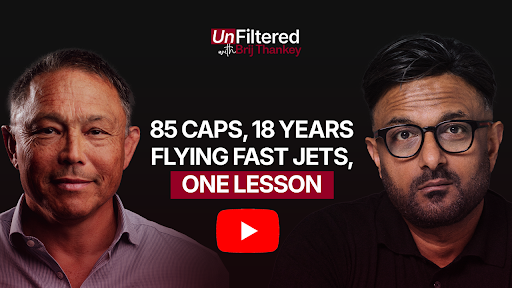
Rory Underwood MBE represented England 85 times and scored 49 tries, becoming one of the most clinical wingers of his generation. Alongside rugby, he served for 18 years in the Royal Air Force, flying fast jets at around 420 knots and as low as 250 feet during peacetime training.
In Episode 7 of Unfiltered with Brij, Rory reflects on what rugby, the RAF and building a business taught him about performing alongside others.
He later turned those experiences into a career advising organisations and founding Wingman, the leadership consultancy he leads as CEO. Across that work, he has explored one question: why do some teams consistently outperform others with similar talent?
Rory’s answer is not another recruitment formula or strategy framework. Talent matters, but it is rarely what separates a group of capable individuals from a team that performs consistently. The greater advantage is the environment in which those people work.
Finding Balance Between Rugby, Flying and Family
Rory’s rugby career would be almost impossible to replicate today. The sport was still amateur when he played internationally, so there was no full-time England squad training every morning. He continued his RAF career, trained on Tuesday and Thursday evenings and played on Saturday afternoons.
Yet he did not experience rugby, flying and family life as three pressures accumulating on top of one another. Each gave him a way to step away from the demands of the others.
“I used each of them to sort of help me decompress in a way.” — Rory Underwood
Flying gave him distance from rugby. Rugby gave him an outlet from flying. Returning home to his two daughters helped him reconnect with what mattered beyond both. He learnt to give his full attention to the environment he was in rather than carrying every pressure into the next one.
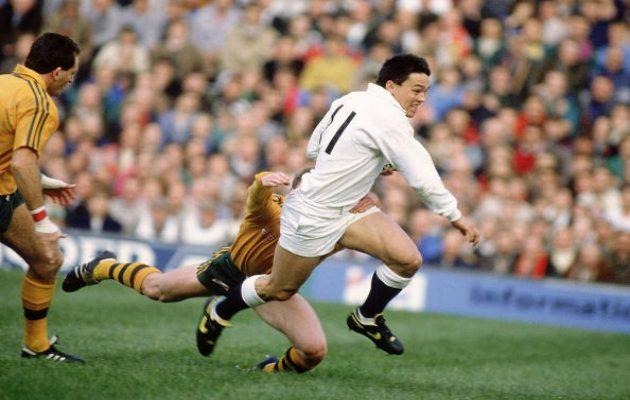
Rory Underwood carrying the ball during an England rugby match.
Learning What Makes a Team Work
Talent is easy to notice and easy to overvalue. Rory has worked alongside exceptional people in cockpits, on rugby pitches and in boardrooms. Across all three environments, natural ability alone rarely explained who performed best under pressure.
He recalls an RAF rugby match for which the team arrived late and had only about 20 minutes to change before going onto the pitch. There was no time to overthink tactics or perfect a complicated plan.
“That 15 that went on the pitch actually just figured out everything else. Just get this working as a team; we just concentrate on that.” — Rory Underwood
It became one of the best matches he ever played. What stood out in Rory’s recollection was how quickly the players found a way to work together when preparation time disappeared.
Rory later saw the opposite pattern inside businesses: departments could meet their individual targets while collectively pulling the organisation in different directions.
“Everybody thinks their priority is the most important one.” — Rory Underwood
Sales pursues one result, operations another and finance a third. Each function can appear successful while the organisation as a whole stalls. Leaders often assume alignment exists because the strategy has been announced, but hearing a strategy is not the same as understanding how your work contributes to it.
From Elite Performer to Business Founder
Rory did not move into business by following a plan laid out years in advance. At 38, he looked at the direction of his RAF career and decided it was no longer the future he wanted. He originally intended to become a British Airways pilot, but another opportunity led him into consultancy instead.
Starting a business proved to be a very different test from anything he had encountered in rugby or aviation.
“I left the Air Force, made a conscious decision to leave. I could have stayed in, but to leave and go and start a business — that was a real eye-opener. Anybody [who has] started a business from scratch, you learn very quickly.” — Rory Underwood
After the financial crash in 2008, he made another major decision: to leave that business and establish his own. Rory speaks openly about the importance of his wife’s support through those changes. The pattern across his career is not that every transition was obvious or comfortable; it is that he was prepared to recognise when one chapter had ended and commit himself to learning the next.
Wingman grew from the patterns Rory had observed across sport, the military and business. Its central concern is the gap between strategy and execution: why capable people, working hard, can still fail to move in the same direction.
During the conversation, Rory describes around 25–26 years of advising organisations, with Wingman in its current form accounting for 17 of those years.
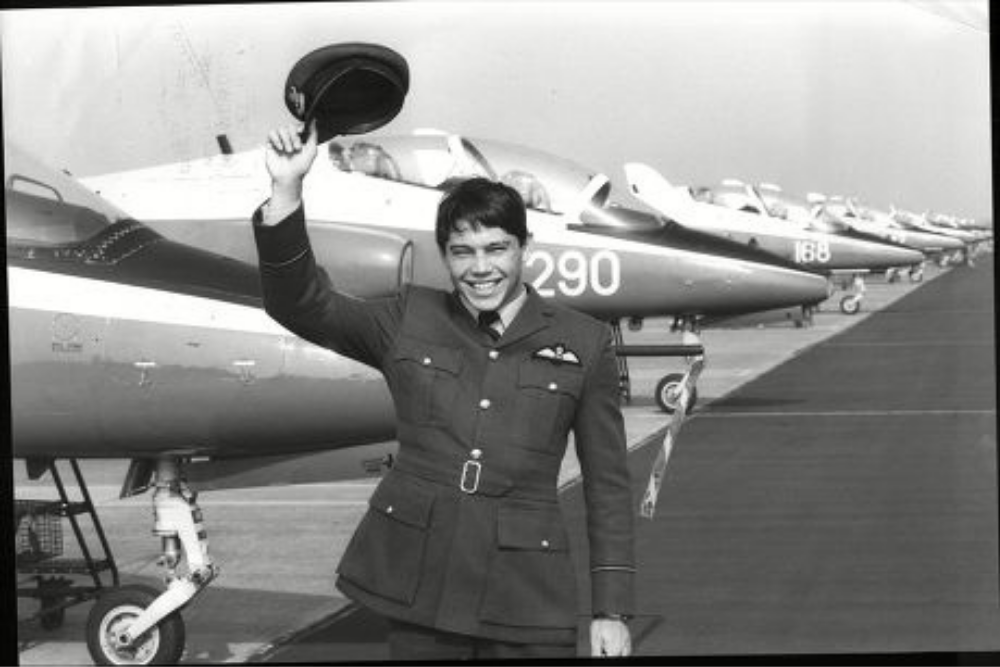
Rory Underwood standing beside an RAF aircraft
The Assumption That Holds Teams Back
When Brij asked which leadership habit every CEO should stop, Rory’s answer was immediate:
“Assuming everybody knows what they’re supposed to be doing.” — Rory Underwood
That answer brings the three parts of Rory’s life together. A rugby player needs to understand how his role serves the team. A pilot must know the mission, the procedure and the consequences of deviating from them. Employees need the same fundamental clarity about direction and contribution.
Rory is not advocating micromanagement. His experience suggests that leaders create stronger teams when they make the destination and responsibilities clear, then give capable people room to deliver.
The conversation leaves a simple impression: Rory’s achievements are remarkable, but he is less interested in presenting himself as an exceptional individual than in understanding what allows a group of people to perform well together. That question connects the winger, the pilot and the business founder — and it is what makes his perspective worth hearing in full.
For the practical lessons from the conversation, read Building a High-Performing Team: 5 Lessons From Rory Underwood MBE.
Watch or Listen to the Full Conversation
This article captures only part of Rory Underwood MBE’s conversation with Brij Thankey.
The full episode explores his England rugby career, life in the RAF, the discipline behind sustained performance and why clarity may be one of the most valuable things a leader can give a team.
Watch the full episode on YouTube, or listen on Spotify and Amazon Music.
More conversations like this are available at brijthankey.com.